Most email marketing platforms track everything—when subscribers open emails, what links they click, their location, device, and more. This data feeds into elaborate analytics dashboards that marketers love but subscribers never consented to in any meaningful way.
The platforms on this list take a different approach. Some minimize tracking by default. Some hand you a kill switch for every tracking feature. Others let you self-host entirely so the data never leaves your infrastructure. I’ve gone through their privacy policies, documentation, and actual settings—not just the marketing copy—to give you an honest picture of where each one stands.
Short answer: For most newsletter operators, Buttondown is the clear pick—open tracking is off by default, the privacy stance is genuine (it’s a solo-built product, not a VC-funded data machine), and the free tier covers you until 100 subscribers. If you need full data sovereignty or run a list at scale, Mailcoach (self-hosted, one-time license) or Listmonk (free, open source) give you complete infrastructure control.
Why Email Marketing Privacy Matters Now
Email marketing has a tracking problem most marketers don’t think about. The standard approach involves invisible tracking pixels—tiny 1×1 images embedded in emails that ping a server when opened. These pixels can reveal:
- Exact time and how many times someone opened your email
- Approximate location based on IP address
- Device type and email client
- Whether the email was forwarded
Click tracking goes further, routing every link through the platform’s servers to log what subscribers click and when.
The landscape is changing. Apple’s Mail Privacy Protection, introduced in iOS 15, now pre-fetches tracking pixels, making open rates unreliable for a significant portion of subscribers. Other email clients are following suit. Meanwhile, regulations like GDPR require legitimate interest or consent for tracking—something most email signup forms don’t properly obtain.
Why subscribers care: Research from Pew Research shows 79% of Americans are concerned about how companies use their data. When subscribers learn their reading habits are being tracked, it erodes trust. Privacy-conscious brands are turning this into a competitive advantage.
The business case is straightforward. Opt-in tracking produces cleaner data. A smaller number of subscribers who actively click links tells you more than inflated open rates from image pre-fetchers. And if you’re in the EU or serve EU customers, fewer tracking toggles means fewer compliance landmines.
What Makes an Email Platform “Privacy-Focused”
“GDPR compliant” is a low bar. Every platform slaps that label on their pricing page. Privacy-focused means something stricter—the product is architected around data minimization, not built to maximize data collection and then bolted with a compliance checkbox.
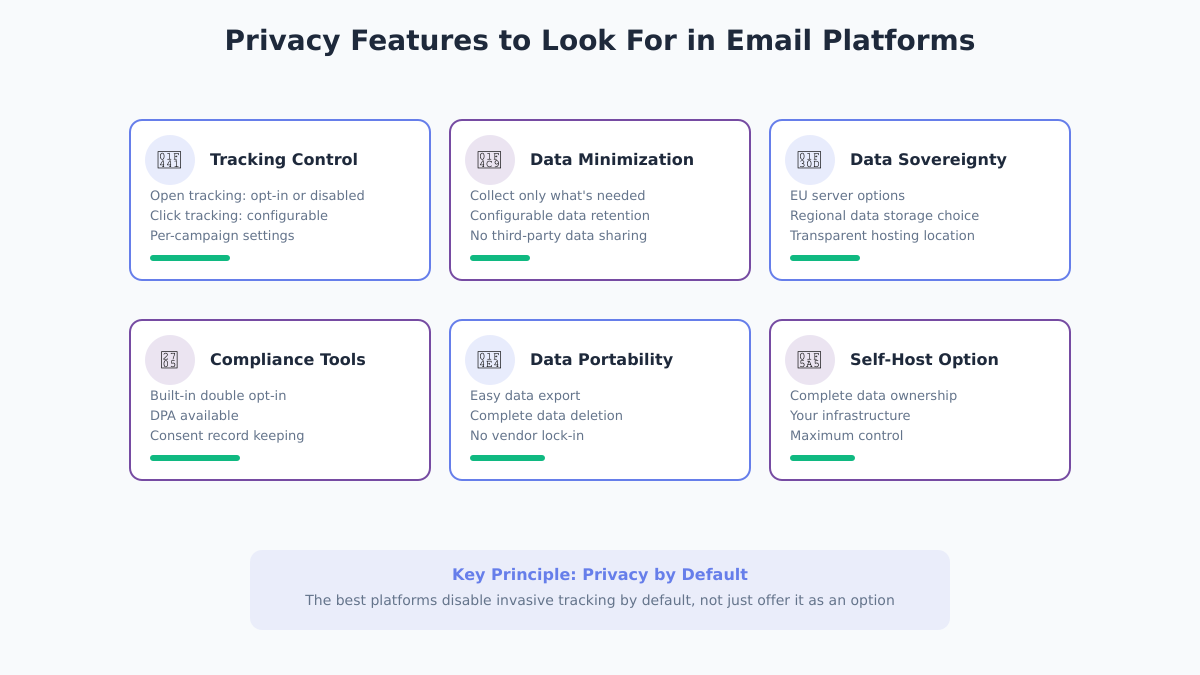
Data minimization: The platform collects only what’s necessary. No tracking by default, no excessive data retention, no selling data to third parties. This aligns with GDPR’s data minimization principle under Article 5.
Tracking transparency: You control whether tracking pixels and click tracking are enabled. Some platforms let you disable tracking entirely. Others make it opt-in rather than opt-out.
Consent management: Built-in double opt-in, easy unsubscribe, and consent records. The platform helps you maintain proper consent documentation.
Data sovereignty: Where are servers located? Can you choose EU-based hosting? For some organizations, this matters significantly for compliance.
Self-hosting option: The ultimate privacy control—running the platform on your own servers where you control everything.
| Privacy Feature | What to Look For | Red Flag |
|---|---|---|
| Open tracking | Disabled by default or optional | Always on, can’t disable |
| Click tracking | Optional per-campaign or disabled | Mandatory for all links |
| Data retention | Configurable, auto-deletion options | Indefinite retention |
| Third-party sharing | None, or clearly disclosed | Vague privacy policy |
| Server location | Choice of region, EU options | US-only, no transparency |
| Export/deletion | Easy data export and deletion | Difficult or impossible |
The 7 Best Privacy-Focused Email Marketing Platforms
These platforms stand out for taking privacy seriously—in actual product decisions, not just landing-page copy.
1. Buttondown — Best for Minimal, Privacy-First Newsletters
Buttondown is built by a solo developer who explicitly prioritizes privacy. No investor roadmap pressuring him to monetize subscriber data. No bloated feature set. Just reliable newsletter delivery with the right defaults.
Open tracking is off unless you turn it on. Click tracking is optional per-newsletter. There are no third-party tracking scripts embedded in the platform’s interface. It collects the minimum necessary: your subscribers’ emails and whatever metadata you explicitly choose to add.
Privacy features:
- Open tracking disabled by default (opt-in)
- Click tracking optional per-newsletter
- No third-party tracking scripts
- Minimal data collection—just email and optional metadata
- GDPR-compliant with EU subscriber handling
Pricing: Free up to 100 subscribers. Paid plans start at $9/month for unlimited subscribers with basic features.
Limitations: No visual drag-and-drop builder — Buttondown uses Markdown. Automation is limited compared to full marketing suites. Segmentation is basic. If you need complex drip sequences or A/B testing, look elsewhere.
Best for: Writers, independent publishers, and anyone who wants the simplest possible privacy-first newsletter without managing a server.
2. Mailcoach — Best Self-Hosted Option
Mailcoach from Spatie is a polished Laravel application you can run on your own server. Your subscriber data never touches Mailcoach’s infrastructure. You choose the sending service (Amazon SES, Postmark, Mailgun) and control the database. That’s the privacy promise — and unlike a hosted platform’s assurances, this one is structurally enforced.