Most email marketing platforms track everything—when subscribers open emails, what links they click, their location, device, and more. This data feeds into elaborate analytics dashboards that marketers love but subscribers never consented to in any meaningful way.
After testing dozens of email platforms for privacy practices, I’ve identified seven that take a genuinely different approach. These platforms either minimize tracking by default, give you full control over what data you collect, or let you self-host entirely.
This guide compares privacy-focused email marketing platforms based on actual privacy features, not just marketing claims. You’ll find options ranging from free open-source tools to polished commercial products—all prioritizing subscriber trust over surveillance.
Why Email Marketing Privacy Matters Now
Email marketing has a tracking problem most marketers don’t think about. The standard approach involves invisible tracking pixels—tiny 1×1 images embedded in emails that ping a server when opened. These pixels can reveal:
- Exact time and how many times someone opened your email
- Approximate location based on IP address
- Device type and email client
- Whether the email was forwarded
Click tracking goes further, routing every link through the platform’s servers to log what subscribers click and when.
The landscape is changing. Apple’s Mail Privacy Protection, introduced in iOS 15, now pre-fetches tracking pixels, making open rates unreliable for a significant portion of subscribers. Other email clients are following suit. Meanwhile, regulations like GDPR require legitimate interest or consent for tracking—something most email signup forms don’t properly obtain.
Why subscribers care: Research from Pew Research shows 79% of Americans are concerned about how companies use their data. When subscribers learn their reading habits are being tracked, it erodes trust. Privacy-conscious brands are turning this into a competitive advantage.
Business benefits of privacy-first email:
- Build genuine trust with your audience
- Simplified GDPR/CCPA compliance
- More accurate metrics (when tracking is opt-in, data is meaningful)
- Differentiation in crowded markets
- Future-proofing against stricter privacy regulations
What Makes an Email Platform “Privacy-Focused”
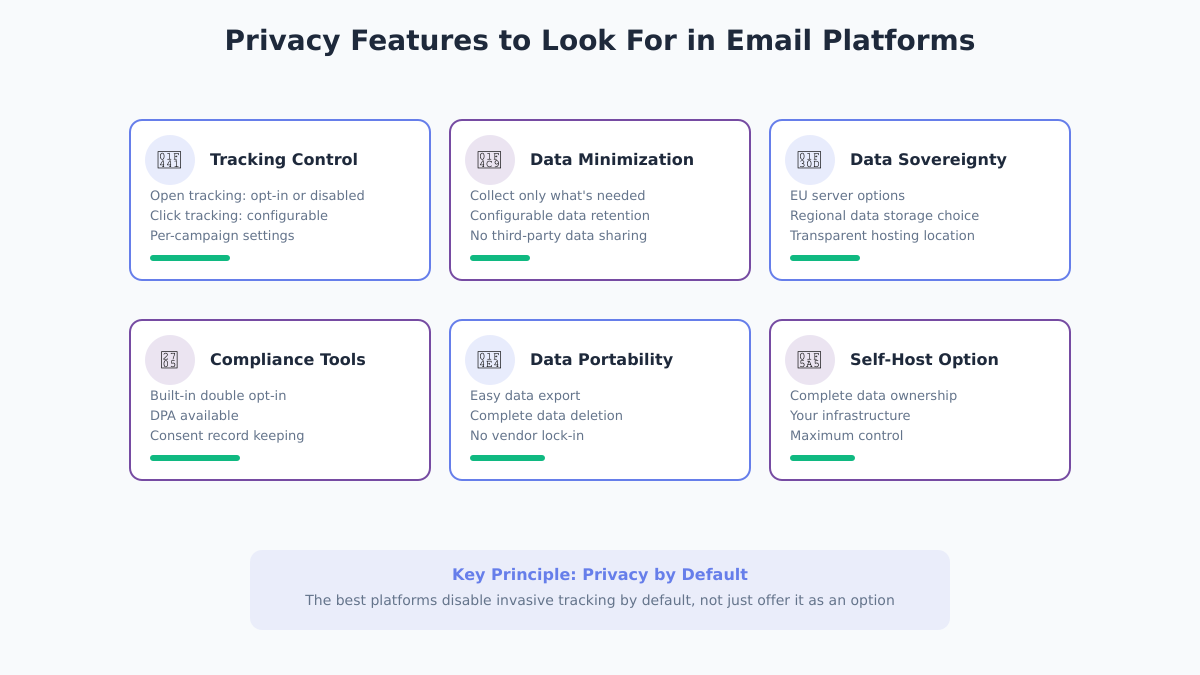
Not every platform claiming to be “GDPR compliant” is actually privacy-focused. Compliance is the legal minimum—privacy focus goes further. Here’s what to look for:
Data minimization: The platform collects only what’s necessary. No tracking by default, no excessive data retention, no selling data to third parties. This aligns with GDPR’s data minimization principle under Article 5.
Tracking transparency: You control whether tracking pixels and click tracking are enabled. Some platforms let you disable tracking entirely. Others make it opt-in rather than opt-out.
Consent management: Built-in double opt-in, easy unsubscribe, and consent records. The platform helps you maintain proper consent documentation.
Data sovereignty: Where are servers located? Can you choose EU-based hosting? For some organizations, this matters significantly for compliance.
Self-hosting option: The ultimate privacy control—running the platform on your own servers where you control everything.
| Privacy Feature | What to Look For | Red Flag |
|---|---|---|
| Open tracking | Disabled by default or optional | Always on, can’t disable |
| Click tracking | Optional per-campaign or disabled | Mandatory for all links |
| Data retention | Configurable, auto-deletion options | Indefinite retention |
| Third-party sharing | None, or clearly disclosed | Vague privacy policy |
| Server location | Choice of region, EU options | US-only, no transparency |
| Export/deletion | Easy data export and deletion | Difficult or impossible |
The 7 Best Privacy-Focused Email Marketing Platforms
These platforms stand out for taking privacy seriously—not just in marketing copy, but in actual product decisions.
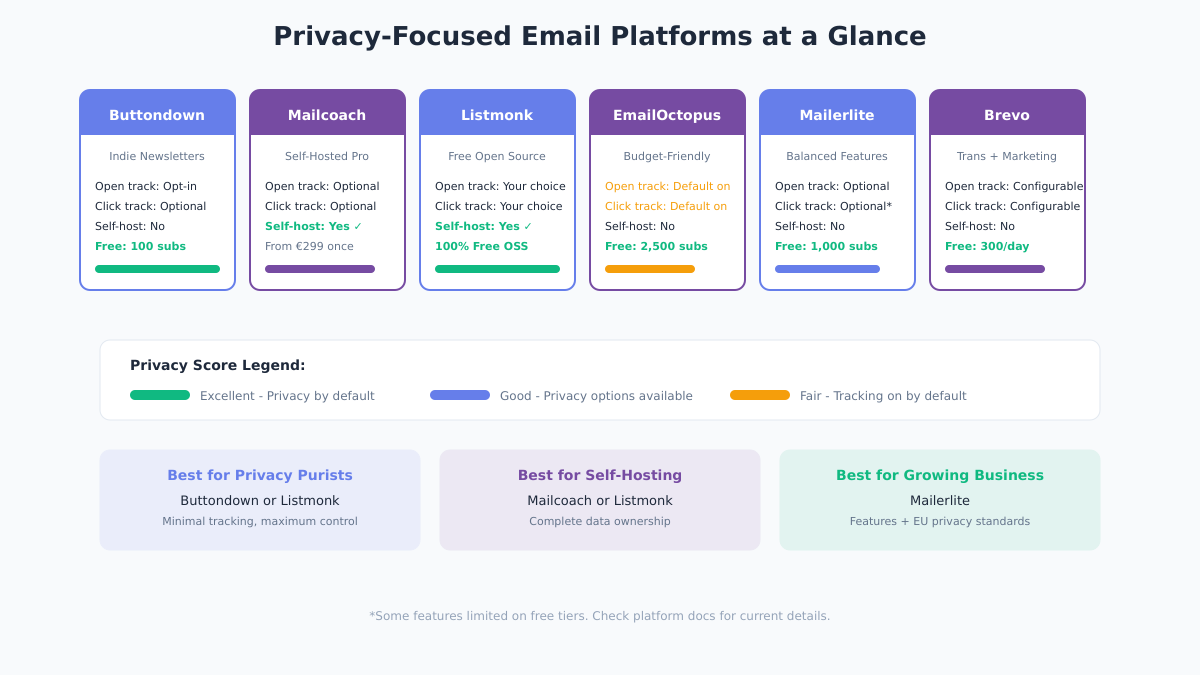
1. Buttondown — Best for Minimal, Privacy-First Newsletters
Buttondown is built by a solo developer who explicitly prioritizes privacy. It’s refreshingly minimal—no bloated features, just reliable newsletter delivery with privacy-respecting defaults.
Privacy features:
- Open tracking disabled by default (opt-in)
- Click tracking optional per-newsletter
- No third-party tracking scripts
- Minimal data collection—just email and optional metadata
- GDPR-compliant with EU subscriber handling
Pricing: Free up to 100 subscribers. Paid plans start at $9/month for unlimited subscribers with basic features.
Limitations: Limited automation compared to larger platforms. No visual email builder—uses Markdown. Basic segmentation.
Best for: Writers, bloggers, indie creators who want a simple, privacy-respecting newsletter without complexity.
2. Mailcoach — Best Self-Hosted Option
Mailcoach from Spatie offers the best of both worlds: a polished commercial product that you can self-host on your own servers. Your data never leaves infrastructure you control.
Privacy features:
- Full self-hosting—complete data control
- Open and click tracking optional (your choice)
- No data shared with third parties (it’s your server)
- Integrates with your own email sending (Amazon SES, Postmark, etc.)
- Full audit trail and data export
Pricing: One-time license starting at €299. Cloud-hosted option also available if self-hosting isn’t for you.
Limitations: Requires technical knowledge to set up and maintain. You’re responsible for server security and updates.
Best for: Developers, agencies, and businesses with technical resources who want complete control over their email infrastructure.
3. Listmonk — Best Free Open-Source Solution
Listmonk is a free, open-source, self-hosted newsletter and mailing list manager. It’s surprisingly feature-rich for a free tool and gives you absolute control over subscriber data.
Privacy features:
- 100% self-hosted—you own all data
- Open source with transparent code
- Tracking entirely under your control
- No external dependencies or third-party services
- Works with any SMTP provider
Pricing: Free and open source. Costs are only for your hosting infrastructure.
Limitations: Requires server administration knowledge. Limited built-in templates. Community support only (no commercial support).
Best for: Technical users, privacy advocates, and organizations that need complete data sovereignty without licensing costs.
4. EmailOctopus — Best Budget-Friendly Privacy Option
EmailOctopus offers straightforward email marketing with honest privacy practices at competitive prices. It’s not positioned as a “privacy tool,” but its practices are solid.
Privacy features:
- GDPR compliant with clear data processing
- EU hosting available
- Minimal data collection beyond email
- Easy data export and deletion
- No selling of subscriber data
Pricing: Free up to 2,500 subscribers. Paid plans from $8/month with more features and higher limits.
Limitations: Open and click tracking are on by default (can be disabled). Less privacy-focused positioning than others on this list.
Best for: Small businesses and startups wanting affordable email marketing with decent privacy practices.
5. Mailerlite — Best Balance of Features and Privacy
Mailerlite is a full-featured email marketing platform that’s made genuine efforts toward privacy, including launching from Lithuania (EU) with GDPR built into its foundation.
Privacy features:
- EU-based company and data processing
- GDPR compliance tools built in
- Option to disable open tracking per campaign
- Strong consent management features
- Clear, readable privacy policy
Pricing: Free up to 1,000 subscribers with limited features. Paid plans from $9/month.
Limitations: Click tracking can’t be fully disabled on free plan. Some features require higher tiers.
Best for: Growing businesses that need automation, landing pages, and advanced features while maintaining privacy standards.
6. Brevo (formerly Sendinblue) — Best for Transactional + Marketing
Brevo handles both marketing emails and transactional messages (password resets, receipts) on one platform. As a French company, GDPR compliance is deeply integrated.
Privacy features:
- EU-based with strong GDPR compliance
- Data stored in EU data centers
- Built-in consent management
- Configurable tracking options
- ISO 27001 certified security
Pricing: Free up to 300 emails/day. Paid plans from $25/month based on email volume.
Limitations: Tracking enabled by default. Interface can feel complex. Daily sending limits on free tier.
Best for: Businesses needing both transactional and marketing email with EU data residency requirements.
7. Postmark — Best for Deliverability-Focused Privacy
Postmark focuses on transactional email but added broadcast (marketing) capabilities. They’re known for exceptional deliverability and transparent practices.
Privacy features:
- Open tracking opt-in per message stream
- Click tracking configurable
- No selling or sharing subscriber data
- Clear data retention policies
- SOC 2 Type II certified
Pricing: From $15/month for 10,000 emails. No free tier, but offers 100 free test emails.
Limitations: More expensive than competitors. Broadcast features less mature than marketing-focused platforms.
Best for: SaaS companies and businesses where email deliverability is critical and privacy is a core value.
Platform Comparison Table
| Platform | Open Tracking | Click Tracking | Self-Host | Free Tier | Best For |
|---|---|---|---|---|---|
| Buttondown | Opt-in | Optional | No | 100 subs | Indie creators |
| Mailcoach | Optional | Optional | Yes | No | Developers |
| Listmonk | Your choice | Your choice | Yes | Free OSS | Technical users |
| EmailOctopus | Default on | Default on | No | 2,500 subs | Budget-conscious |
| Mailerlite | Optional | Optional* | No | 1,000 subs | Growing businesses |
| Brevo | Configurable | Configurable | No | 300/day | Transactional+Marketing |
| Postmark | Opt-in | Configurable | No | No | Deliverability focus |
*Mailerlite click tracking has limitations on the free plan
Privacy Features Deep Dive
Understanding how email tracking works helps you make informed decisions about what to enable or disable.
Tracking Pixel Alternatives
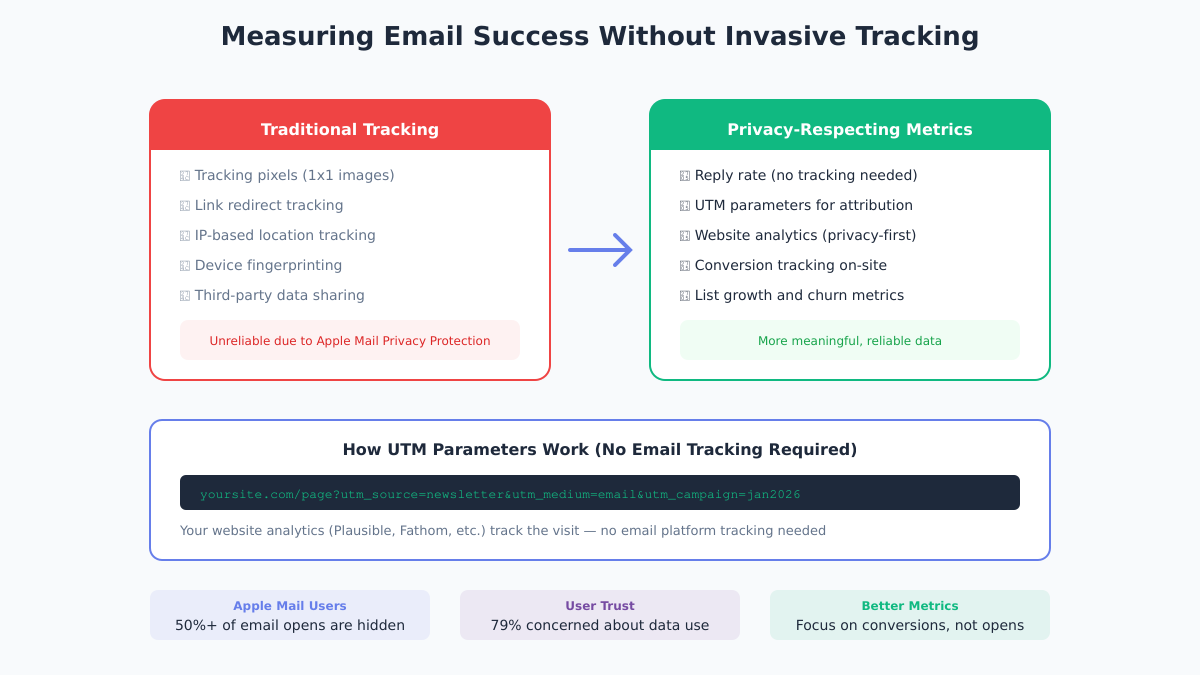
If you disable open tracking, you lose open rate data. But open rates have become increasingly unreliable anyway due to:
- Apple Mail Privacy Protection pre-fetching images
- Corporate email filters blocking tracking pixels
- Privacy-focused email clients blocking remote images
Better metrics to focus on:
- Click-through rate — Measures actual engagement (though consider making this opt-in too)
- Reply rate — Direct engagement that requires no tracking
- Conversion metrics — Track on your website with privacy-friendly analytics
- List growth/churn — Subscriber behavior over time
- Revenue attribution — Use UTM parameters instead of email tracking
Click Tracking: The Privacy Trade-off
Click tracking routes links through the email platform’s servers. This allows measuring which links get clicked but means:
- The platform sees every click
- Links look suspicious to savvy subscribers (long redirect URLs)
- Potential security concerns if the tracking service is compromised
Privacy-respecting alternative: Use UTM parameters on your links. You’ll see traffic sources in your website analytics without the email platform tracking individual clicks.
Instead of: platform-tracked-link.com/redirect/abc123

Use: yoursite.com/page?utm_source=newsletter&utm_medium=email&utm_campaign=jan2026
Self-Hosting Considerations
Self-hosting (Mailcoach, Listmonk) gives maximum privacy control but comes with responsibilities:
Pros:
- Complete data ownership
- No third-party access to subscriber data
- Choose your own hosting jurisdiction
- No ongoing platform fees (beyond hosting)
Cons:
- You’re responsible for security updates
- Deliverability depends on your setup
- Need technical knowledge or team
- Backup and disaster recovery is on you
How to Evaluate Email Platform Privacy
Before committing to a platform, do your own privacy audit.
Questions to ask:
- Can I disable open tracking completely? Is it default on or off?
- Can I disable click tracking? Per-campaign or globally?
- Where is subscriber data stored? Can I choose the region?
- What data is collected beyond email addresses?
- How long is data retained? Can I configure this?
- Is there a clear data processing agreement (DPA) for GDPR?
- Can I easily export all subscriber data?
- Can I delete all data when I leave?
Privacy policy red flags:
- Vague language about “partners” or “service providers”
- No mention of data deletion rights
- Claiming rights to use your data for “improving services”
- No DPA or GDPR-specific documentation
- US-only data storage with no alternatives
Email Platform Privacy Audit Checklist:
- Read the privacy policy (not just skim it)
- Check if a DPA is available and review it
- Test the platform with tracking disabled
- Verify data export functionality works
- Confirm where servers are located
- Check what happens to data if you close your account
- Look for independent security certifications (SOC 2, ISO 27001)
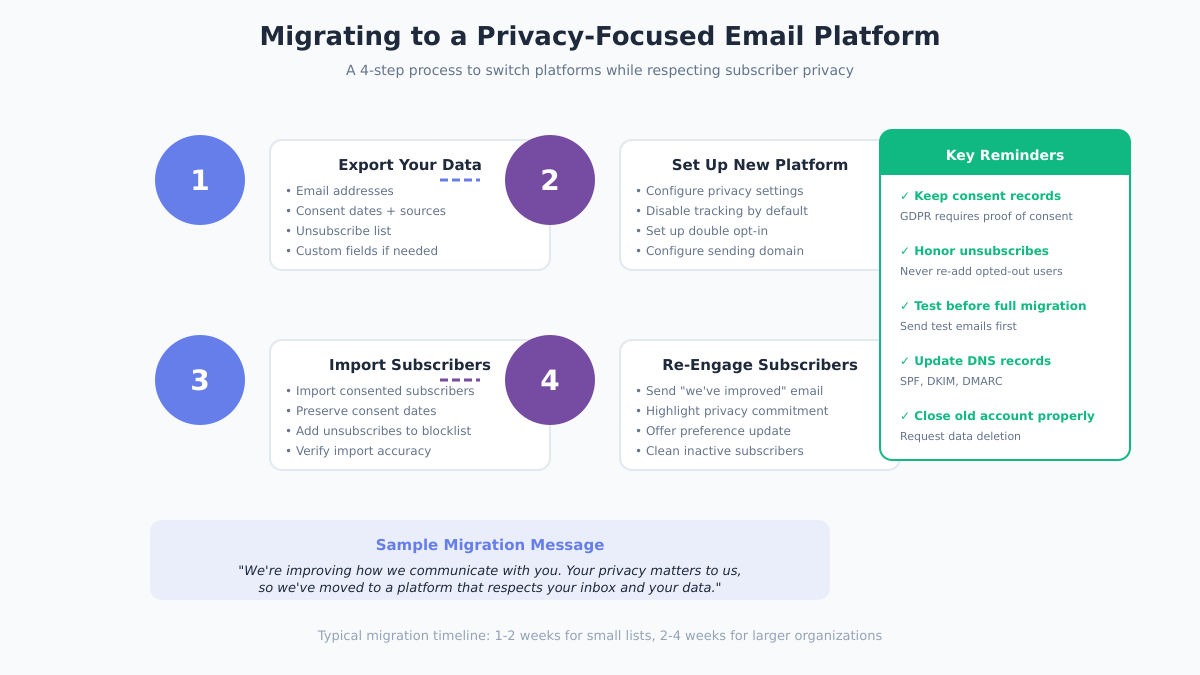
Migrating to a Privacy-Focused Platform
Switching email platforms doesn’t have to compromise privacy—if done correctly.
Export Your Subscriber List Properly
From your current platform, export:
- Email addresses
- Consent dates (when they subscribed)
- Consent source (which form/page)
- Any custom fields you need
- Unsubscribe list (don’t email these people again)
Important: Keep consent records. GDPR requires you to demonstrate when and how subscribers gave consent. If your old platform has this data, export it before closing your account.
Handling Consent During Migration
If your subscribers consented to emails from you, you can generally migrate them to a new platform—you’re not changing the sender, just the tool. However:
- Don’t use migration as an excuse to email people who unsubscribed
- Honor existing preferences (frequency, topics)
- Consider sending a “we’re updating our newsletter” message
- If consent records are unclear, consider a re-confirmation campaign
Re-engagement Best Practices
Migration is a good time to clean your list and re-engage dormant subscribers:
- Send a “We’re improving how we communicate” email explaining your privacy improvements
- Give subscribers a chance to update preferences
- Remove subscribers who haven’t engaged in 12+ months (after a re-confirmation attempt)
- Frame the privacy focus as a benefit: “We’re committed to respecting your inbox and your data”
FAQ
Can I still measure email performance without tracking pixels?
Yes. Focus on click-through rates (if you choose to track clicks), reply rates, conversions on your website (measured with cookieless analytics), list growth, and revenue metrics. These are often more meaningful than open rates anyway. Apple’s Mail Privacy Protection has already made open rates unreliable for a large segment of subscribers.
Is self-hosted email marketing worth the effort?
It depends on your situation. Self-hosting makes sense if you have technical resources, handle sensitive subscriber data, need complete data sovereignty, or want to avoid ongoing SaaS costs at scale. For most small businesses, a privacy-respecting hosted platform like Buttondown or Mailerlite is simpler and sufficient.
Do privacy-focused platforms have worse deliverability?
Not necessarily. Deliverability depends on factors like sender reputation, authentication (SPF, DKIM, DMARC), content quality, and list hygiene—not tracking. Platforms like Postmark are both privacy-respecting and industry-leading in deliverability. Self-hosted solutions require more work to achieve good deliverability but can match commercial platforms with proper setup.
How do I explain tracking changes to stakeholders?
Frame it around reliability and trust: “Open rates are increasingly unreliable due to Apple Mail Privacy Protection and corporate email filters. We’re shifting focus to metrics that actually reflect engagement—clicks, replies, and conversions. This also helps us build trust with subscribers who increasingly expect privacy.” Most stakeholders care about business results, not open rate vanity metrics.
Recommendations by Use Case
For indie creators and bloggers: Start with Buttondown. It’s simple, privacy-first by default, and free until you grow. If you’re technical and want free + open source, try Listmonk.
For small businesses: Mailerlite offers the best balance of features, usability, and privacy. EU-based with solid GDPR compliance. EmailOctopus is a good budget alternative.
For enterprises with compliance requirements: Brevo (EU data centers, ISO certified) or Mailcoach (self-hosted for maximum control). Both offer the compliance documentation enterprises need.
For developers who want full control: Mailcoach for a polished self-hosted experience with good support. Listmonk for completely free and open source. Both let you choose your own email sending infrastructure.
Ready to make the switch? Start by auditing your current platform’s privacy practices using the checklist above. You might be surprised what data is being collected without your subscribers’ meaningful consent. For more on building marketing without invasive tracking, explore our Cookieless Marketing guides.
Want to understand the broader privacy landscape? Check out our guide on cookie consent best practices or browse our tool reviews for more privacy-focused alternatives.